


Since the launch of ChatGPT in November 2022, Generative Artificial Intelligence has captured global attention, and rightfully so. Its potential to transform business processes is undeniable. However, despite the enthusiasm, many leaders remain cautious, concerned about the risks, complexity, and costs associated with its implementation, which often overshadows the immense possibilities it offers.
Among the main challenges AI presents through LLMs (Large Language Models) are "hallucinations" and outdated knowledge. Hallucinations are incorrect statements presented as facts, such as when an LLM claims that "The Statue of Liberty has been in Toronto since 1915" (a fact that is, as we know, incorrect, as it was inaugurated in New York in 1886... or was it 1884? Well, in any case, not in Toronto!), illustrating the ability of these models to generate grammatically correct but factually inaccurate statements.
Another significant risk is outdated knowledge, also known as "knowledge cutoff". LLMs are trained on an extensive text corpus up to a specific date, which means they may struggle to provide accurate information on events after that date. For example, an LLM might respond with: "Sorry, I don't have information about events that occurred after September 2023."
These challenges raise crucial questions: How can we ensure the reliability of information provided by an AI assistant? Is it necessary to constantly retrain the model to keep it up-to-date?
Differentiator
In response to these challenges, an innovative technique has emerged that is revolutionizing the way LLMs access and use information: Generative Augmented Retrieval (RAG). RAG allows LLMs to overcome their limitations by accessing external, updated information sources, providing more accurate, contextualized, and reliable responses.
The goal of a RAG system is to combine the text generation capability of language models with external information retrieval. In simpler terms, a RAG feeds the user's prompt with relevant data extracted from a proprietary knowledge base before generating the response. This way, the model can base its answers on specific and updated information obtained from authoritative sources, rather than relying solely on what it "remembers" from its training, thus reducing the risks of hallucinations and outdated knowledge.
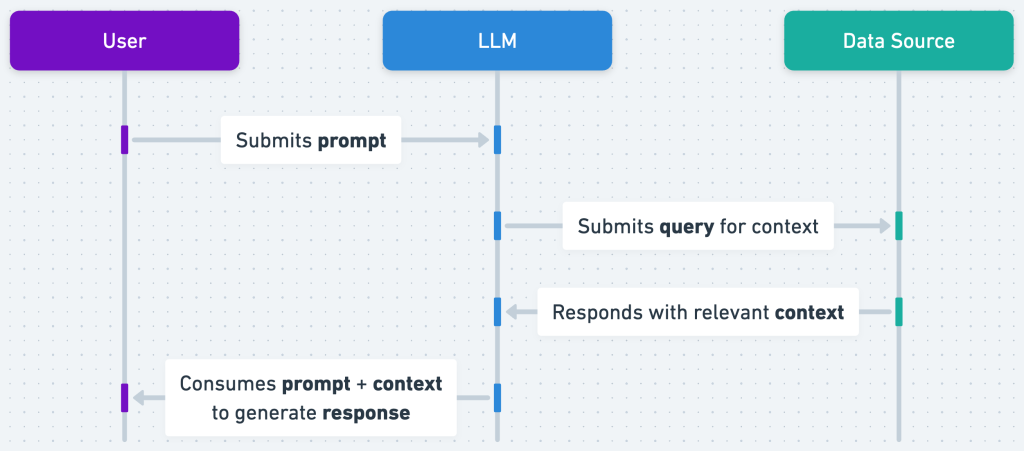
In practice, a RAG system typically includes an LLM, along with a retrieval or search component (e.g., a semantic search engine or an internal database) that provides the necessary data to respond accurately. Before generating the response, RAG searches through relevant documents and supplies that context to the model, ensuring that the output references accurate and contextualized information.
At Mottum Analytica, we have worked with RAG technology to offer an alternative that allows businesses to keep their data under control in private and secure environments. Our solutions enable implementation on the company’s own servers or on a secure, private cloud, and are offered through various consumption channels such as the web or WhatsApp, adapting to each client's needs.
When is RAG recommended?
It is important to highlight that LLMs are highly versatile models, capable of doing much more than simply generating text. Their potential spans creative content creation, engaging in complex conversations, identifying, recognizing, and analyzing images (not just text!), and even extracting valuable information from documents.
Therefore, RAGs are especially recommended when we want to minimize the risks of hallucinations, that is, when accuracy and truthfulness are critical, such as in legal, medical, or business environments where responses must be based on up-to-date and verifiable data. RAGs are also useful when real-time or rapidly changing information is required, such as in the financial or journalistic sectors.
Moreover, in general, one of the most valuable use cases is when there is a need to integrate internal or specialized data, such as proprietary databases or specific documents. This saves the significant cost of training models with these sources of information.
Risks
Implementing a RAG solution requires integrating various complex technological components: an LLM, a semantic search engine, a robust document database, and sophisticated orchestration logic that enables seamless interaction between these components. Properly configuring and maintaining this technological ecosystem presents significant challenges in terms of development, scalability, and performance. All of this becomes even more complicated if there is no prior experience in developing and implementing such systems.
Another important challenge lies in the proper handling of sensitive information. Direct use of LLMs like ChatGPT often involves sending queries and potentially confidential company data to external servers, such as those of OpenAI or, as in the recent case with DeepSeek, servers located in China. This practice may violate internal information security policies or external regulations (such as those related to personal data protection, client confidentiality, trade secrets, etc.). It is crucial to consider the legal and security implications before implementing any solution that involves processing sensitive data by third parties.
Conclusion
LLMs and RAG represent two complementary aspects of the AI revolution in the business world. LLMs, with their remarkable ability to generate natural language, have opened the world's eyes to the potential of AI in communication and content creation tasks. The RAG technique, on the other hand, emerges as an effective response to the need for accessing updated and accurate information, building a crucial bridge between the vast general knowledge possessed by a model and the specific, contextual data handled by an organization.
It is expected that the most robust and efficient AI solutions will combine both approaches in a synergistic manner. At Mottum, we create intelligent assistants capable of maintaining a natural and open dialogue (in the style of ChatGPT), but in the background, they consult databases, reports, the web, and other relevant information sources to ground each response with accuracy and context. This combination enables the creation of more reliable, informative AI systems tailored to the specific needs of each organization.
Write to us if you need to implement a RAG-based solution to "talk" with your information securely, or even if you want to understand more about how it works and how it could simplify your data management.